Throw pillows can make a living room look finished in minutes… or make it feel cluttered and “try-hard” just as fast. The designer secret isn’t having more pillows—it’s using the right sizes, a simple odd-number formula, and a setup you can reset in under 5 minutes.
This guide is a no-product, no-link, real-life method you can use with what you already own.
Why throw pillows often look “off”
From experience, most pillow setups fail for three reasons:
- All pillows are the same size (flat, store-display vibe)
- Too many patterns (visual noise)
- No “anchor” pillow (nothing feels grounded)
Fix those three and your couch instantly looks intentional.
Step 1: Choose your pillow count (odd numbers win)
Designers love odd numbers because they look relaxed and natural.
The easy rule
- Small loveseat / apartment sofa: 3 pillows
- Standard 3-seat sofa: 5 pillows
- Large sectional: 5–7 pillows (but only if you actually use the seats)
Real-life tip: If people always toss pillows on the floor, you have too many. The best setup is the one you’ll keep.
Step 2: Use the “Designer Size Ladder”
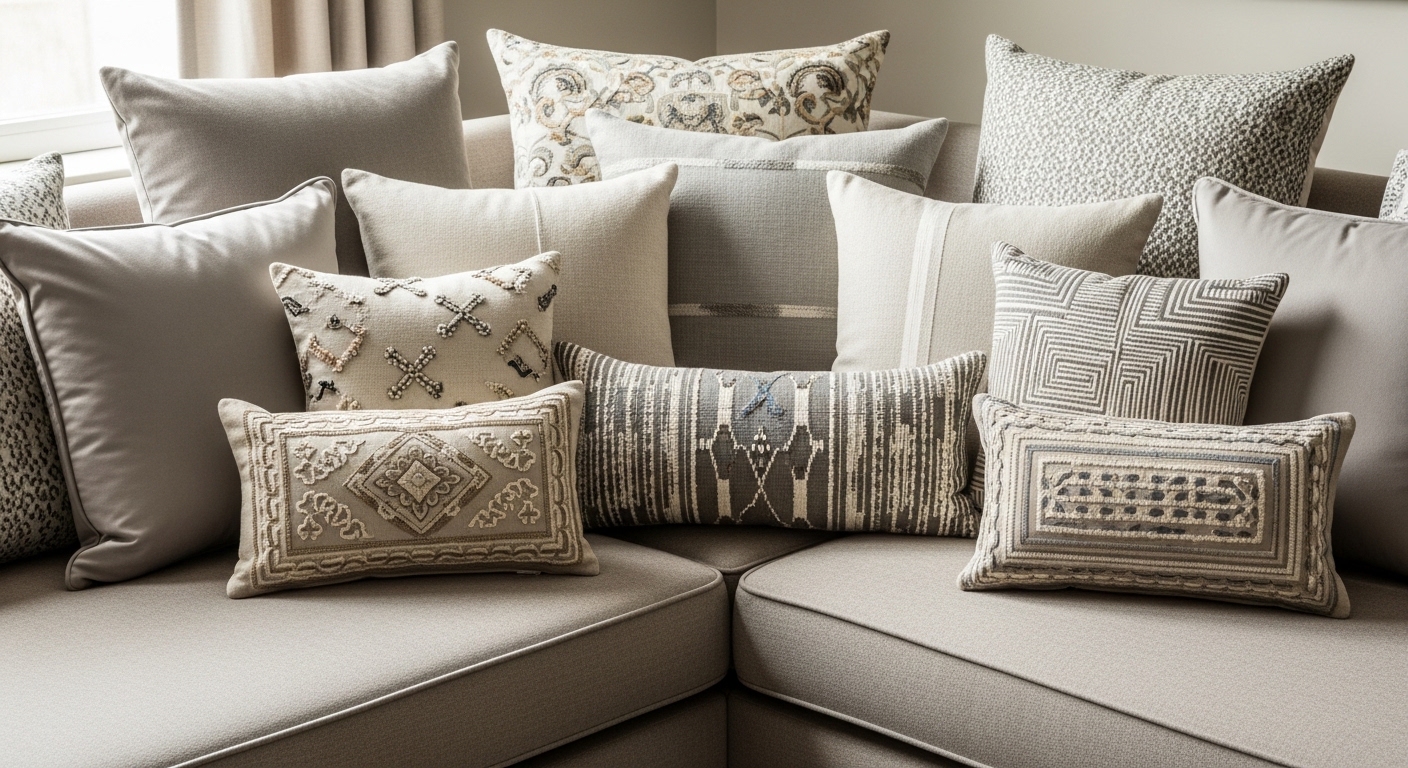
The easiest way to make pillows look expensive is to mix sizes on purpose.
A foolproof size formula
For a standard sofa, use:
- 2 large pillows (back corners)
- 2 medium pillows (in front of the large)
- 1 small accent (front center)
That’s your 5-pillow designer layout.
Why it works
Large pillows create structure. Medium pillows create depth. The small one adds personality without chaos.
My experience: When I switched from “all the same size” to a size ladder, the couch went from “fine” to “styled” without changing colors or buying new anything.
Step 3: The 60/30/10 color method (so it doesn’t look busy)
This prevents “random pillow syndrome.”
- 60%: your sofa color + main room color (base)
- 30%: a secondary color in the room (rug, curtains, art)
- 10%: an accent (one bold color OR a metallic/contrast trim)
Simple example
If your room is neutral:
- 60% cream/gray tones
- 30% warm tan/olive/blue-gray
- 10% black, rust, mustard, or deep navy
Real-life tip: Repeat the accent color somewhere else (a book spine, vase, wall art) so it looks intentional.
Step 4: Pattern rule that always looks “designer”
Patterns are fine—too many patterns is the problem.
Use the “1-1-1” pattern mix
- 1 solid (or subtle texture)
- 1 simple pattern (stripe, small checks)
- 1 organic pattern (abstract, floral, curved lines)
Or for a calmer look:
- 2 solids + 1 pattern
My go-to: stripes are the easiest “designer cheat” because they look clean and structured.
Step 5: Texture is what makes it look expensive
Even when colors are simple, texture does the heavy lifting.
Mix two to three textures:
- knit / woven
- linen-like
- velvet-like
- boucle-like
- faux fur (sparingly)
Real-life tip: If your sofa is smooth (leather, tight weave), add at least one pillow with a chunky texture to avoid a flat look.
The 5-minute “No-Mess” setup (my reset routine)
This is the method that keeps pillows from becoming a daily chore.
0:00–1:00 — Clear + anchor
- Put two large pillows on the back corners first.
- Make sure they sit upright and match height.
1:00–3:00 — Layer forward
- Place two medium pillows in front of the large ones.
- Slightly angle them inward (not perfectly straight).
3:00–4:30 — Add the accent
- Add one small pillow in the center or slightly off-center.
- Off-center looks more natural.
4:30–5:00 — Fluff + chop (optional)
- Give pillows a quick fluff.
- If your pillows hold shape well, a light “karate chop” crease can look polished.
- If not, skip it—over-chopping can look forced.
My experience: The “angle inward” step alone makes it look styled—straight lines often look stiff and staged.
Layouts that always work (by couch type)
Loveseat (3 pillows)
- 1 large corner
- 1 medium in front
- 1 small accent near center
This keeps seating usable.
Standard sofa (5 pillows) — most designer-friendly
- 2 large (back corners)
- 2 medium (front corners)
- 1 small (center)
Sectional (5–7 pillows)
- Treat each “side” like its own mini-sofa.
- Don’t pile pillows where people actually sit.
Real-life rule: If you’re constantly moving pillows to sit down, reduce the count.
Common mistakes (and quick fixes)
Mistake 1: Too many tiny pillows
Fix: Use fewer, bigger pillows as the base.
Mistake 2: Everything matches perfectly
Fix: Add one contrasting texture or one slightly different shade.
Mistake 3: Patterns compete
Fix: Keep patterns in the same color family and vary scale (one big, one small).
Mistake 4: Pillows slide everywhere
Fix: Put grippier textures behind, smoother textures in front, and keep the biggest pillows as anchors.
“Designer” results with minimal effort: my best advice
If you only do three things:
- Use an odd number (3 or 5)
- Mix at least two sizes
- Add texture, not more colors
…your living room will instantly look more finished, without feeling overstyled.
FAQ (SEO-friendly)
How many throw pillows should be on a couch?
Most couches look best with 3 (small sofas) or 5 (standard sofas). More only works if you still have usable seating.
Do throw pillows have to match?
No. They should coordinate, not match. Repeating one accent color in the room makes it feel intentional.
What’s the easiest “designer” pillow combination?
A size ladder (large + medium + small) and a simple 60/30/10 color mix.