If you live in an apartment, “better sound” isn’t just about bigger explosions. It’s about clear dialogue at lower volumes, less bass rumble through walls, and a setup that fits your space (and your patience).
Here’s how soundbars and home theater systems compare in real life—and which one makes the most sense for apartments and close neighbors.
The real difference
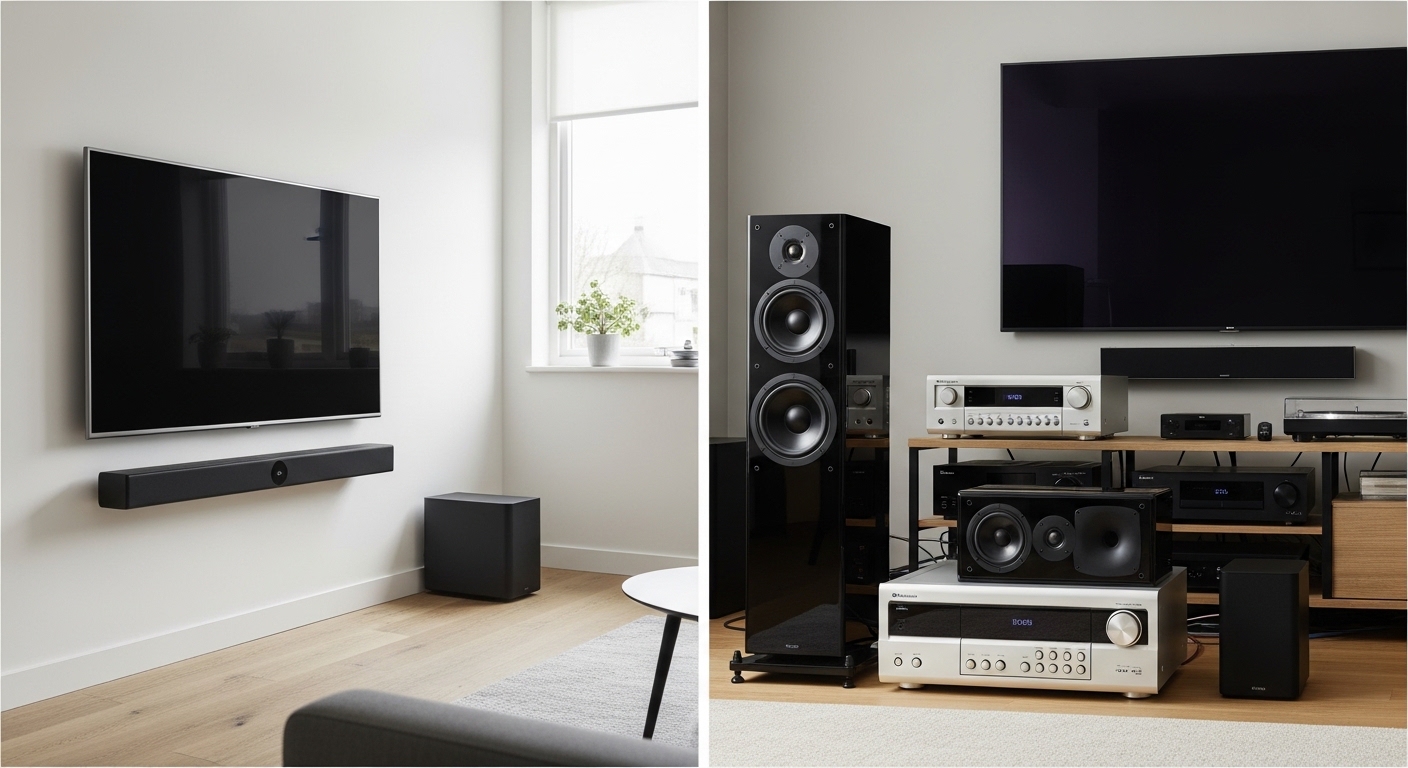
Soundbar
A single bar (sometimes with a subwoofer and optional rear speakers) designed for simple setup and a cleaner look. Many models use processing to simulate surround.
Home theater system
Multiple speakers placed around the room (often with an AV receiver) for true surround sound and stronger separation between dialogue, music, and effects.
Apartments & neighbors: what matters most
1) Bass travels… a lot
Low-frequency bass creates pressure waves that can make floors and walls vibrate, which is why neighbors complain even when your volume doesn’t feel “that loud.”
Translation: the subwoofer is usually the problem, not the voices.
2) Dynamic range is the enemy at night
Movies are mixed with huge volume swings (whispers → explosions). “Night mode” (dynamic range compression) reduces those swings so you can hear dialogue without cranking volume.
3) Setup friction is real
If it’s annoying to use, you won’t use it properly. Apartments reward systems that are easy to control day-to-day.
Soundbar: pros & cons for apartment living
Why soundbars often win in apartments
- Simple footprint: one bar, minimal clutter.
- Easy “neighbor mode”: many include night mode / speech enhancement, so you can keep volume lower while still understanding dialogue.
- Less temptation to go huge: fewer speakers = fewer placement headaches.
Where soundbars can disappoint
- Surround realism varies: simulated surround can’t always match real speaker separation.
- Subwoofer can still annoy neighbors: even small subs can cause rumble if placed badly.
- Limited upgrade path: you often replace the whole unit rather than upgrade one piece at a time.
Apartment sweet spot: a 2.0 or 2.1 soundbar with strong dialogue mode and a subwoofer you can turn down hard (or skip entirely).
Home theater: pros & cons for apartment living
Why home theater can still be worth it (even in an apartment)
- Best dialogue separation: a dedicated center channel (in many setups) can make voices clearer without boosting overall volume.
- True surround: actual rear speakers = real immersion, not “virtual.”
- Upgradeable: you can improve speakers/sub later instead of replacing everything.
Where home theater is tough in apartments
- Space + wiring: speaker placement and cable routing can get annoying fast.
- Bass is more capable (and more risky): great for movies, but easier to upset neighbors.
- More settings: amazing if you like tinkering, exhausting if you don’t.
Apartment sweet spot: a 3.0 system (Left/Center/Right, no sub) or a 5.0 system with bass kept conservative. This gives clarity and surround without the worst neighbor complaints.
“Better sound” for apartments: what I’d choose
Choose a soundbar if you want…
- Quick setup, clean look, minimal wiring
- Better dialogue without fuss
- A system you’ll actually use every day
Best match: most apartments, most people.
Choose home theater if you want…
- Real surround and the clearest separation
- A system you can upgrade over time
- You’re willing to place speakers properly (and manage bass carefully)
Best match: larger apartments, corner living rooms, or anyone serious about movies.
A simple decision rule
- If you share walls/floor with sensitive neighbors: start with soundbar (no sub) or home theater 3.0.
- If you can play moderately loud sometimes: soundbar with adjustable sub or home theater 5.0.
- If you want “cinema” and have more freedom: home theater 5.1/7.1 (but this is rarely “apartment-friendly” without careful bass control).
Setup tips that keep neighbors happier (works for both)
- Turn on Night Mode / DRC for evening watching.
- If you have a subwoofer: lower sub level first, then adjust volume.
- Avoid placing the sub right against a shared wall or directly on bare floors.
- Use dialogue enhancement instead of turning the whole system up.
One connectivity note (optional but useful)
If you care about higher-quality audio formats and simpler TV-to-audio hookup, eARC generally supports more audio formats than ARC thanks to higher bandwidth.
In practice: streaming dialogue clarity is more about tuning and modes than eARC—but eARC can reduce compatibility headaches.
Bottom line
For most apartment living rooms, a dialogue-focused soundbar is the most practical win. If you’re chasing the best “real surround” experience, a home theater 3.0 or 5.0 setup is the apartment-friendly way to do it—without leaning on heavy subwoofer bass that travels.